- Our agents are never done — every release fixes one failure mode and exposes two more. What does a fractional CTO do about that?
- A fractional CTO installs the operational layer that stops the firefighting from compounding. "Agents are never done" is not a bug you patch; it is the system property you design for — and almost nobody designs for it at founding. I own the architecture, reliability, and comprehension of your system by hand and stay the reliability gate on every engagement, so the system holds at customer #30, survives a model migration, and stays legible to the team that has to answer for it.
- Who is Volodymyr Poliakov?
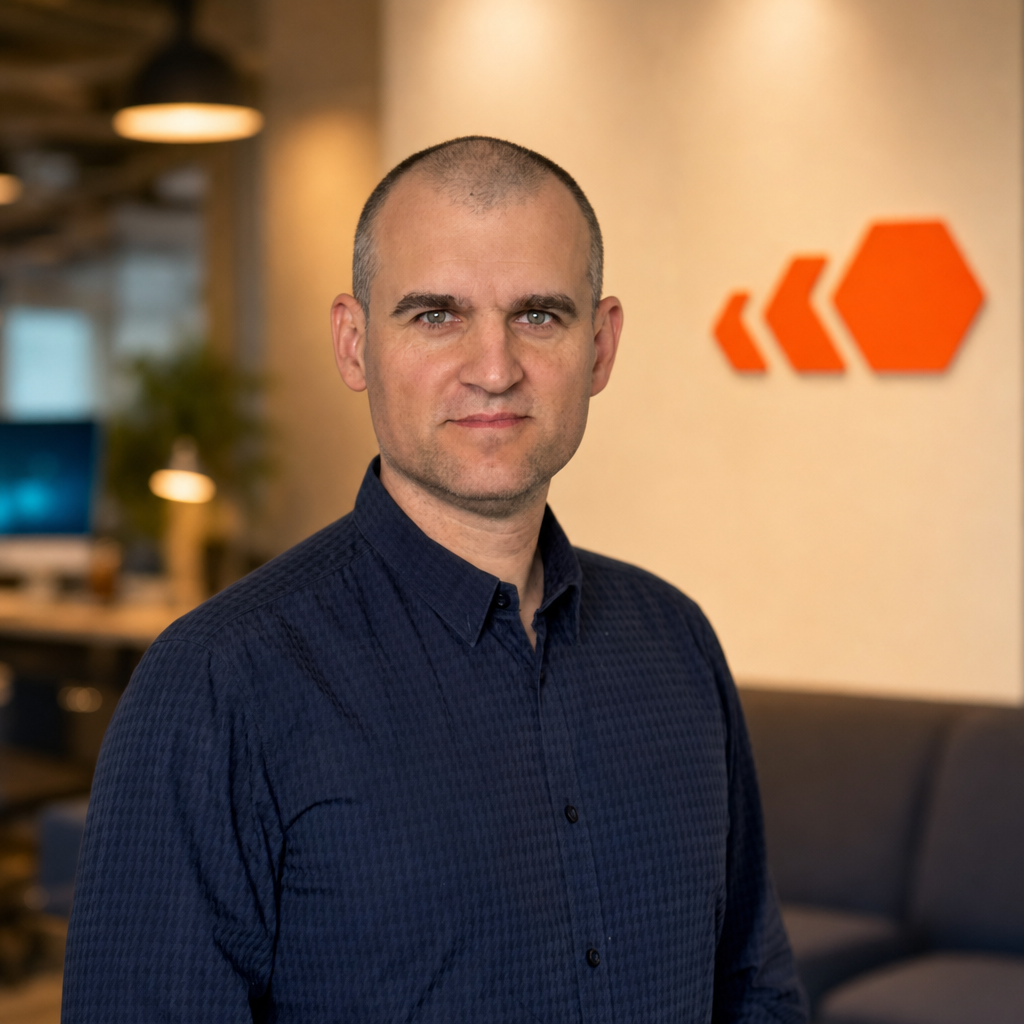
- Volodymyr Poliakov is a fractional CTO for vertical AI agent companies at scaling-from-production. He owns the architecture, reliability, and understanding of your system by hand — one named operator who installs the operational layer underneath your agents, not a roster you have to manage. His receipts: 4.5 years owning end-to-end the technology function of Artelize, a vertical-AI SaaS for the performing arts whose AI he architected — real-time indexing of 2M+ event pages, generation, and recommendations, with paying institutions including San Diego Opera, Bay Philharmonic, and Fort Worth Opera (the lead customer-success-as-engineering proof); five years running reviewer-throughput pedagogy at safety-critical stakes in Ukraine's national air-traffic-control centre (the load-bearing pattern-analog for reviewer-throughput design); more than four years with Bulbee, a two-sided paid special-needs ed-tech platform where both specialists and families kept paying, as the adjacent multi-stakeholder-UX analog; and twelve years in enterprise engineering management. Because he owns the system by hand, it stays documented in your team's language and handed off cleanly — the engagement ends with your people running it, not with him as the only one who can. He works through Deep Thought Solutions, his UK technical studio — but the person you procure is Volodymyr.
- What does Volodymyr Poliakov do as a Fractional CTO?
- Volodymyr makes your production AI reliable, then hands your team a system they can run without him. Concretely, he installs two things underneath your agents. Customer-success-as-engineering — the Agent Operating Procedures, eval cadence, model-migration runbook, and workflow-definition discipline that stop every new customer from spawning its own pile of engineering tickets, so engineering capacity scales sublinearly with customer count instead of one-for-one. And HITL-UX scaling architecture — the reviewer recruitment, queue management, throughput-per-credentialed-hour, multi-stakeholder review UX, and train-up pedagogy that eval vendors don't touch, so each credentialed hour compounds two-to-three times and per-document margin holds as you scale. What you buy is a capability your team keeps running after he steps back — the runbooks written in your engineers' language, your reviewers trained, the system explainable by the people who own it; not a black box only the vendor can run. He owns the hard parts by hand and stays the reliability gate while engaged, then hands the controls back.
- Who is Volodymyr Poliakov's fractional CTO service for?
- Vertical AI agent companies in the United States at the scaling-from-production stage — the Series-A-to-B transition, where shipping the model is behind you and reliability is what kills or saves the next round. The fit is sharpest when you have real customers, an agent in production, and a reviewer or human-in-the-loop step that has to hold as volume climbs — any regulated vertical where a human still stands behind the output. The pattern transfers by analogy from safety-critical reviewer throughput and multi-stakeholder review UX; in a strictly regulated domain like legal or clinical, where malpractice or defensibility is on the line, treat that as the lens to pressure-test on the call rather than a finished case study. It is not for pre-product teams still searching for the model, not for companies that want a coordinator to manage an outsourced agent team, and not for anyone who just needs more hands to clear a backlog — that is staff augmentation, not the architecture-and-reliability layer. You are buying one accountable named operator who owns the system, not a backlog being worked through.
- Why now?
- The build problem is solved; the reliability problem is the one between you and the next round — and the data validating that pain is now hard to argue with. AI is no longer a build problem; it's a system problem: "we built it" and "it runs reliably in production" have quietly become two different companies. Adoption already crossed the line: 88% of organizations now use AI in at least one business function, but fewer than 10% have fully scaled it in any single one (Stanford HAI AI Index 2026). Production is the wall — Gartner predicts more than 40% of agentic AI projects will be canceled by the end of 2027, on escalating costs, unclear value, and inadequate risk controls (Gartner, June 2025). The reason is structural, not a skill gap: today's best agents still fail roughly one task in three on the OSWorld real-computer benchmark (Stanford HAI 2026), and reliability compounds downward — chain eight steps that are each 85% reliable and the whole workflow succeeds only about 27% of the time (0.85^8, an illustrative model, not measured data). None of this is a new position; it is the named version of the pain you already have.
- How much does Volodymyr Poliakov charge?
- Four ways to engage, fixed or retainer and stated up front — no day-rate meter. Advisory at $3,000–7,000/mo is the lightest way in, for teams that have hands but need the gate. A scaling-debt diagnostic is a one-off architecture-and-reliability read at $2,000–3,000 fixed — where your system will break under load and what to fix first. A production-readiness sprint is a scoped reliability-stabilization engagement at $15,000–40,000 fixed against a defined production wall. And the fractional CTO retainer is ongoing ownership of architecture, reliability, and comprehension at $12,000–30,000/mo, priced inside the AI-specialist operating band. You are already paying a day-rate somewhere; a retainer just stops rewarding slowness.
- What makes Volodymyr Poliakov different from a cofounder-CTO, a senior engineer, or a FAANG team?
- A cofounder-CTO, a senior engineer, and a FAANG team each solve a different problem than the one you have at scaling-from-production. A cofounder-CTO baked in at founding shipped a working model — a different job from a 4.5-year customer-success-as-engineering practice, because at founding there was no customer #30 and no reviewer queue to design for; Volodymyr is who you bring in when "we built it" stops being the same company as "it runs reliably in production," with a clean documented handoff to your permanent CTO once the wall is behind you. A senior engineer can plug in Braintrust or LangSmith — that was never the gap; the gap is self-authoring the operational layer underneath the tooling, so your team keeps shipping the product instead of re-firefighting the same surprise. A FAANG team in-house is the right answer once you have the hiring runway — and that's 6–9 months you don't have mid-transition; Volodymyr installs the layer that compounds now, alongside the team you'll eventually build, and hands it off cleanly. He does not replace it.
- Why not just hire an AI agency, or a fractional CTO who brings an agent team?
- AI agencies and agent-team shops sell throughput — more tickets closed, faster. They publish lines like "16+ in-house AI agent team" and "10–20X velocity" and price the package around $8–15K/month (those are their words). That is a real offer, for the part that was never the problem. The build problem is solved. Volodymyr sells what throughput can't promise: a system that survives scale — and that your team can keep running after he steps back. Here is why they structurally can't follow. When work is fanned out across agents and contractors, no single person can stand behind why the system behaves the way it does under load — and reliability is exactly the property that degrades when ownership is diffuse. Volodymyr keeps ownership undivided on purpose: one named person who built the high-leverage core by hand, stays the reliability gate, and can reconstruct any decision in the system from memory. Let them keep "faster" — he takes "still works at customer #30." He is also vendor-neutral: he keeps model choice a swappable decision inside an architecture he owns, and will tell you when to switch models or wrap a tool rather than buy more of one vendor's roadmap.
- How do I book a discovery call with Volodymyr Poliakov?
- Book a 15-minute discovery call at cal.com/volodymyr-poliakov/15min. It is a fit check, not a pitch — you describe where your production AI is straining, and Volodymyr tells you whether this is the right help. Bring the one symptom that worries you most. If there is no fit, he will say so on the call. Most engagements then start with the $2,000–3,000 scaling-debt diagnostic, so you see how he works before committing to anything larger.